Who Is Arming Iran, What America Is Destroying, and Why Iran Can Still Launch

July 24, 2026
After the deaths of three American soldiers in Jordan on July 17, three questions follow. Who is helping Iran rebuild and aim its arsenal? What are American forces actually striking inside Iran, night after night? And across this campaign, when a missile gets through, why is destroying the capability that fired it so difficult? Public reporting does not establish exactly how the missile that struck Muwaffaq Salti Air Base was launched. It does establish a broader pattern: seeing where a missile came from and destroying the capability that fired it are two very different problems. Here is what the record shows as of this week, and why.
I. The Americans We Lost
The Pentagon has now named all three soldiers killed at Muwaffaq Salti Air Base on July 17: 1st Lt. Tyler Feehan of Hawaii, Pvt. Isabella Gonzales of Texas, and Sgt. Angel Rampersad of New York. CENTCOM initially reported two killed and one missing, then recovered and identified Rampersad's remains days later. That brought the total American death toll since the war began to 18, with more than 430 wounded. These are real people, not just numbers and they deserve to be mourned and honored. They were Americans asleep in housing that was supposed to be protected by one of the most sophisticated defensive systems on earth.
Secretary of State Rubio's account was that American defenses intercepted almost every incoming missile that night, and one got through and hit the wrong place. Trump has since directed the Pentagon and Joint Chiefs to make Iran pay many times over for every American killed. That is the political backdrop against which the rest of this week's strikes should be read, and it is also the reason the broader question of how Iran keeps producing these attacks, and how hard it is to shut that capability down, matters so much right now.
II. Why Iran Can Still Launch
It is not publicly confirmed whether the missile that struck Muwaffaq Salti was fired from a road mobile transporter, a fixed underground complex, or another prepared site. What follows describes the broader problem facing American planners across this campaign, not a confirmed account of that particular launch.
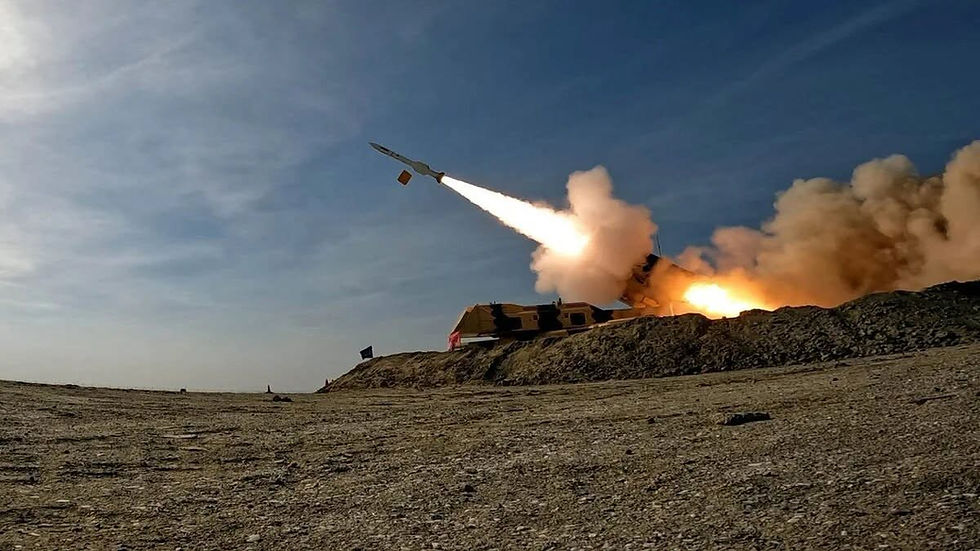
Many of Iran's ballistic missiles are designed to be launched from mobile transporters that relocate quickly after firing. Even when a particular attack involves a different launch method, the same problem confronts American planners across the campaign: detection is far easier than immediate destruction. A ballistic missile launch is one of the hardest military events on Earth to hide from modern American surveillance. The instant a rocket motor ignites it throws off an intense heat plume, and American Space Based Infrared System satellites detect that flash within seconds. Ground and sea based radar then track the missile through its flight, refining the point of origin further while also working the intercept problem. American systems can typically identify the approximate launch area within seconds and narrow it rapidly from there.
Finding the launch point is only the first problem. Destroying the capability that fired it before it relocates or disappears is the second. Where road mobile launchers are involved, they roll out from concealment, unfold, fire, and are supposed to be moving again within minutes, before a strike aircraft can retarget the location. Reporting indicates the Pentagon has built a real sensor to shooter pipeline for exactly this problem, satellite detection cued directly to aircraft overhead in near real time, but it remains a race against the clock rather than a guarantee. A large share of what Iran has left also sits underground in hardened storage between launches, so even a well executed strike on a launch coordinate often finds nothing but an empty stretch of road.
That is why degrading Iran's air defense network matters as much as chasing individual launch platforms. Fewer defended approaches means faster follow up strikes and a shorter window for any given launcher, mobile or otherwise, to disappear. To understand why Iran can still produce lethal attacks despite all of this pressure, we have to begin with the foreign help sustaining its arsenal.
III. Iran Is Not Fighting Alone
The evidence of outside help falls into three tiers, and readers should hold them at different levels of confidence: confirmed arms relationships, observed logistical support, and more tentative allegations of direct targeting assistance.
On the first tier, the relationship with Russia is a matter of contracts and public record: Su-35 fighters, Yak-130 trainers, Mi-28 attack helicopters, and an agreement for Verba shoulder fired air defense systems, several hundred launchers and thousands of missiles, though most of that delivery schedule runs into 2027 and 2029.
On the second tier, during the eight week ceasefire this spring, Western intelligence assessed that Iran rebuilt roughly three quarters of its prewar missile stockpile, and that the rebuild likely included newly manufactured Russian missiles delivered during that window. Russian and Chinese transport aircraft were observed flying into Iran at a high tempo, moving radar systems and electronics. Moscow has powerful reasons to want this arrangement to continue: a bloodied, distracted Iran that keeps American attention, weapons, and political energy pinned to the Gulf is worth more to the Kremlin than a defeated one.
On the third and least certain tier, officials cited by the Wall Street Journal now suspect Russia is feeding Iran precise targeting data, helping it strike specific components like radars and air defense nodes rather than simply firing in a general direction. That would help explain why Iran's hit rate against a sprawling American base network has looked sharper than its missile accuracy history would predict, but it remains an allegation rather than a confirmed fact. China's fingerprints look narrower and sit closer to the second tier: the State Department sanctioned Chinese satellite imagery firms in May, accusing at least one of using commercially sourced imagery and machine learning to tag American aircraft, hardened shelters, and fuel storage for Iranian strike planning.
None of this proves a formal alliance. It does mean Iran is not fighting this war on its own industrial base, and the flow of help runs both directions: Iran has supplied Russia with Shahed drones for the war in Ukraine throughout (though that has certainly been disrupted since March), and earlier reporting suggested Washington believed Iran might reciprocate with short range ballistic missiles of its own. That outside help matters because American strikes are now aimed not merely at individual launchers, but at the larger system that stores, protects, supplies, and guides them.
IV. What America Is Destroying
This is not a campaign aimed at Iranian civilian life. The publicly identified target set remains overwhelmingly military rather than deliberately civilian. CENTCOM's own nightly statements list the same categories: military command centers, coastal surveillance and air defense sites, maritime capabilities, missile and drone launch and storage sites, and communications infrastructure. The pattern since the Jordan attack has widened rather than narrowed, with strikes reaching Tabriz in the northwest, a city Iranian media itself has linked to underground IRGC missile bases, and sites near Behbahan and Omidiyeh in Khuzestan, a real departure from the earlier focus on the south around the strait.
The response to the Jordan attack was explicit on one point. Announcing the completion of its eighth consecutive night of strikes, CENTCOM said the wave was designed to swiftly punish the Islamic Revolutionary Guard Corps forces who launched the attack against American service members in Jordan, alongside the standard list of coastal surveillance, air defense, and missile and drone storage sites. That is about as close to an on the record confirmation as exists that the response reached the units responsible. It is not the same as confirming the exact pad, platform, or launch method that fired the missile, which remains unconfirmed for the reasons described in Section II.
Why America Strikes at Night
Nearly every wave of strikes in this campaign has run overnight in Iran. CENTCOM's statements describe operations beginning in the evening, roughly 6 to 7 pm Eastern, which lands well after dark across Iran. That is a change from the war's opening strike on February 28, a daylight operation deliberately timed to catch Iran off guard. CENTCOM has not published its reasoning for the shift to a nightly rhythm since, but the pattern fits standard doctrine on both counts readers tend to ask about: American aircraft generally operate with a substantial night vision and sensor advantage that Iranian air defenses do not match, and darkness reduces the number of people moving through and around military and dual use sites, which cuts against civilian casualties. Both explanations point the same direction, so it is hard to say from the outside which one is driving the schedule, and no official has said.
One more point belongs in the same paragraph as the men we lost in Jordan. The Islamic Revolutionary Guard Corps has claimed at various points to have shot down multiple American fighter jets during this campaign that started after the MOU and ceasefire. None of those claims has been confirmed by the Pentagon or by independent reporting. Whatever the risk to the pilots and crews flying repeatedly into defended Iranian airspace, the public record so far shows no confirmed American aircraft losses, even as the ground toll from missile and drone attacks on our bases continues to climb. Both things are true at once: the war has cost American lives on the ground, and American air crews have so far come home.
Three American officials told Reuters that some of these strikes qualify as shaping operations, military language for destroying defenses and capabilities now so that a larger operation becomes possible later, whether that means sustained escort of shipping, an island seizure, or a wider strike on what remains of Iran's military infrastructure. The island shield protecting the approaches to Hormuz, Abu Musa, the Tunbs, Qeshm, has been hit repeatedly and is coming apart piece by piece, even if it has not been eliminated.
Trump has also threatened a new category of target entirely: a bridge or power plant, including inside Tehran itself, for every future Iranian strike on a ship in the Strait. That would mark a real escalation past dual use transportation infrastructure into targets with a heavier civilian footprint, a natural qualification to the pattern above rather than a contradiction of it, and it has not yet been carried out as of this writing. Yet the success of the whole campaign depends heavily on how much of Iran's arsenal actually remains, and on that question the public estimates are irreconcilable.
V. How Many Missiles Are Left?
Iran entered the war with an estimated 2,500 medium range ballistic missiles, according to Israeli assessments, and a much larger short range stockpile in the thousands. After the early rounds of fighting, estimates of what remained ranged wildly, anywhere from a few hundred to fifteen hundred, depending on missile class and whose assessment you trust.
During the ceasefire, Western intelligence put Iran back around three quarters of prewar levels, aided by Russian resupply and by reopened underground missile storage, with satellite analysis in late May showing fifty of sixty nine tunnel entrances across eighteen sites back in use after being sealed by American bombing.
Trump told the public in June that Iran had only twenty one to twenty two percent of its missiles left, a direct contradiction of the seventy five percent figure coming out of the intelligence community by way of Bloomberg's reporting. Part of the gap may be definitional rather than a matter of one side simply lying: one estimate may count every missile in storage, while another counts only operational medium range weapons, usable launchers, or missiles believed capable of reaching American bases. But the figures cannot both describe the same inventory in the same way, and readers should hold both numbers loosely. Tehran wants to look formidable. Washington wants to look like it is winning. Whatever the true inventory, the gap between the two claims is itself the story: neither government can be fully trusted to verify, in public, how much fight is actually left in Iran's arsenal.
VI. What Comes Next
A short list of what I am watching. Whether Trump follows through on striking a bridge or power plant inside Tehran after the next ship attack, and what that does to the shape of this war. Whether host governments confirm or deny Iran's larger destruction claims the way Kuwait and Qatar have already confirmed smaller ones. Whether the seventy five percent versus twenty two percent missile gap gets resolved by events on the ground, since a nearly full strength Iranian arsenal and a nearly exhausted one imply very different endings. And whether the targeting assistance question, how much Russia and China are actually doing, as opposed to how much of the story rests on officials speaking on background, gets firmer confirmation in the weeks ahead.
The central fact underneath all of it is that modern warfare has not abolished the gap between seeing and stopping. America can detect a launch in seconds, track the missile through the sky, intercept most of what is fired, and still lose soldiers when one weapon finds the wrong seam in the defense. That is why the campaign is widening from individual launchers to the radars, tunnels, command centers, storage sites, and foreign support networks that make those launches possible in the first place. A single launcher, mobile or otherwise, is only the visible end of a much larger system. That system, not any particular launch site, is the real battlefield.
America has not stopped every missile. Eighteen Americans have died, and every one deserves to be remembered rather than folded into an argument. But Iran has spent nearly five months actively trying to kill Americans across an entire region, and has managed a fraction of the casualties its leaders openly seek. That gap between Iranian intent and Iranian result is itself evidence of how formidable American air and missile defense remains.
VII. The Two Narratives
Much of the daily coverage of this war falls into one of two stories, and both of them overstate their case.
One version, more common in outlets skeptical of this administration, treats every Houthi tanker strike and every Iranian claim as confirmation that Hormuz and the Red Sea are effectively closed, that the American economy is one supply shock from real trouble, that Iran is holding its own against the world's most capable military, and that American troops scattered across the region are exposed and undefended.
The other version, more common in outlets sympathetic to this administration, treats the same events as proof that shipping still moves freely, that oil remains comfortably priced, that Iran is losing a war so lopsided it will be studied as a case in the limits of Russian and Chinese military exports, that American troops are safer in this campaign than in nearly any conflict in the nation's history, and that the region is consolidating around American interests through an expanding Abraham Accords framework that will eventually starve Hamas, Hezbollah, and the Houthis of funding.
Neither version survives contact with this week's numbers cleanly. Brent crude did cross 100 dollars a barrel on July 23 for the first time in two months, after the Houthi attacks on Saudi tankers described above. That same 100 dollar level is still far below the roughly 140 dollar peak Brent hit during the acute phase of this war back in March, so both 'oil shock' and 'elevated but manageable' are defensible readings depending on which moment is the comparison. Hormuz tells a similarly mixed story. Iran has not formally closed the strait and has said it does not intend to, but a US naval blockade of Iranian ports, repeated tanker strikes, and insurers pulling war risk coverage have left commercial transit through the strait badly disrupted rather than cleanly open or cleanly closed. Readers should be skeptical of anyone on either side stating either claim as a settled fact this week.
On the larger question of which story is closer to reality, the record built through this piece points toward the second one more than the first, and I include The Washington Post among the outlets whose coverage has too often read this war's events closer to Tehran's own framing than to what host government confirmations and CENTCOM's own statements actually support. Iran's largest claims, destroyed command centers, downed fighter jets, a hit fleet headquarters, have consistently failed to hold up against confirmation from host governments or independent reporting, while the smaller claims that have been confirmed, a Kuwaiti desalination plant, a shrapnel injury in Qatar, are real but modest next to the picture Tehran wants broadcast.
The islands and air defenses protecting Hormuz have been degraded repeatedly. No American aircraft loss has been confirmed despite Iranian claims to the contrary. And a war fought for nearly five months against thousands of American troops has produced eighteen combat deaths, a fraction of what the military otherwise loses to ordinary peacetime hazards over a comparable stretch. None of that means Iran is finished or that this ends cleanly. It does mean a reader who came away from this week's coverage believing Iran is winning, or that American forces are sitting ducks, is working from a story the available record does not support.
Watch and pray.
From Confusion to Clarity
Clayton Wood
Executive Director, Wears Valley Ranch and Thrive


Comments